Operating Systems
One operating system, built around how you run the day.
Six apps, and a corner of each one. A dozen tools on the monthly bill, with about a tenth of them ever opened. ARDNT builds one operating system per client for owner-run trades and service businesses in British Columbia, shaped around how the work already gets delivered.
Five minutes, no call required.
Built With You: an owner-run business on one operating system. 52 seconds, sound on.
Sound familiar?
Paying for a stack of software, using a fraction of it.
-
Six apps, a corner of each
Every subscription arrived for a single job and brought forty features with it. The bill covers all of them, every month, whether or not anyone opens them.
-
A tenth of the tool
The scheduling app works as a calendar. The CRM works as a phone list. The field app works as a camera. Each one is capable of far more, and the day never needs it.
-
The crew quit the last one
It did too much, tracked too much and asked for too many taps at the end of a long day. The work went back to paper inside a month, and the licence kept billing.
-
The day still runs on calls
Dispatch happens by phone. Paperwork lands in a shared drive. Invoicing waits on somebody finding the photo proving the work was finished.
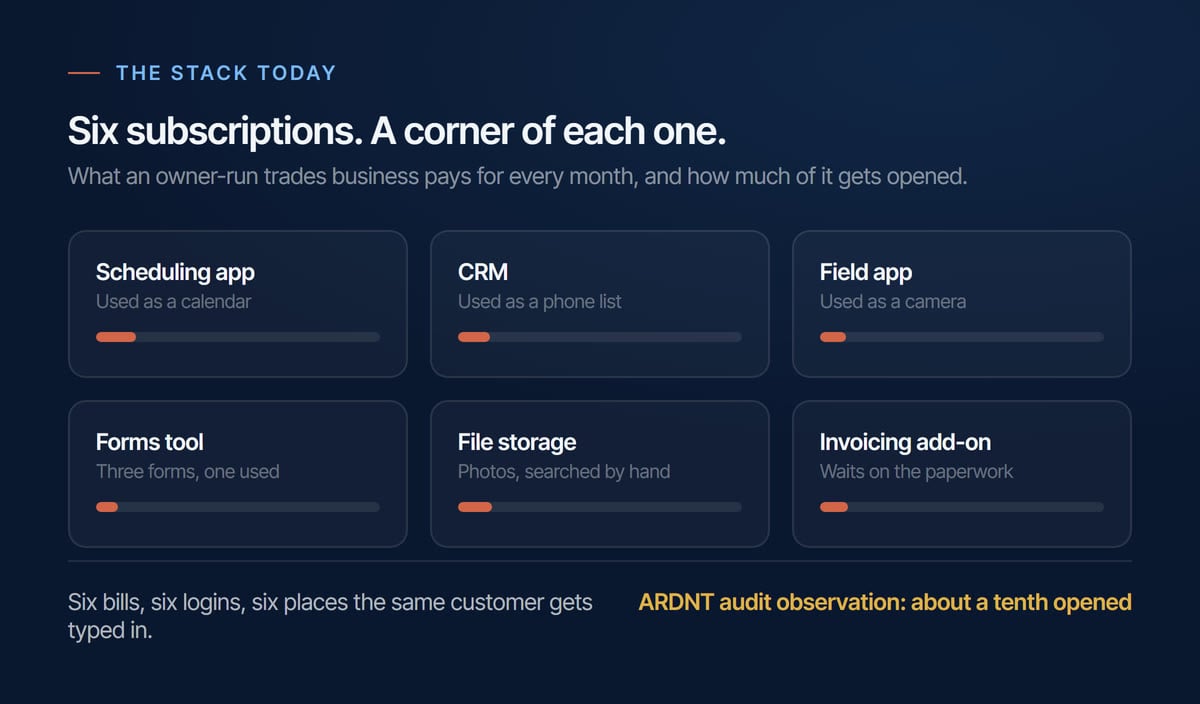
A stack leaks at the joins. Every handoff between two apps is a place where a job stalls, a photo goes missing, or the same customer gets typed in twice. An operating system holds the whole day in one place, and the joins disappear.
The waste shows up in the software industry’s own research. Pendo’s 2019 Feature Adoption Report found 80 percent of features in the average software product are rarely or never used, with 12% of features generating 80% of daily usage. Zylo’s 2026 SaaS Management Index puts average licence utilisation at 54%, with 36% of licences never touched at all. Our own audits keep finding the same shape at a smaller scale: an owner paying for a full suite and opening about a tenth of it.
Why another app won’t fix it
The problem is fit. An operating system starts from the work.
Off-the-shelf software is built for the average business, and the average business is a statistical artefact. Every real company bends to meet it: renaming a field to mean something else, working around a step the vendor left out, keeping a spreadsheet alongside for the part the software refuses to do. Adaptation is the hidden cost of a subscription, and it compounds each time another tool joins the stack.
An operating system runs the other way round. It is built from how one business delivers a job, from the first call to the closed invoice, and it carries only what the job needs. Nothing on the screen belongs to a different industry. Nothing waits on a feature request to a vendor with ten thousand other customers ahead in the queue.
Sometimes a subscription is the right answer. Where an off-the-shelf tool already does a job well, ARDNT says so, and the operating system reports against it. A recommendation to keep what works counts as a finding, and it goes in the audit alongside everything else.
The Operating System
One system runs the day: dispatch, paperwork, office.
The dispatch board is the first surface. Work orders leave one place, each carrying its crew, its window and its address, and the state of every job on the board reads at a glance.
Field paperwork is captured on a phone at the site. Photos, readings, materials and a signature attach to the work order while the crew is still standing there, and a job becomes invoice-ready only once its paperwork is complete.
The office console watches every job move. Nobody phones a technician to ask where a job stands, and invoicing stops waiting on a search through a shared drive. Clock-in stamps the time; nothing tracks your people.
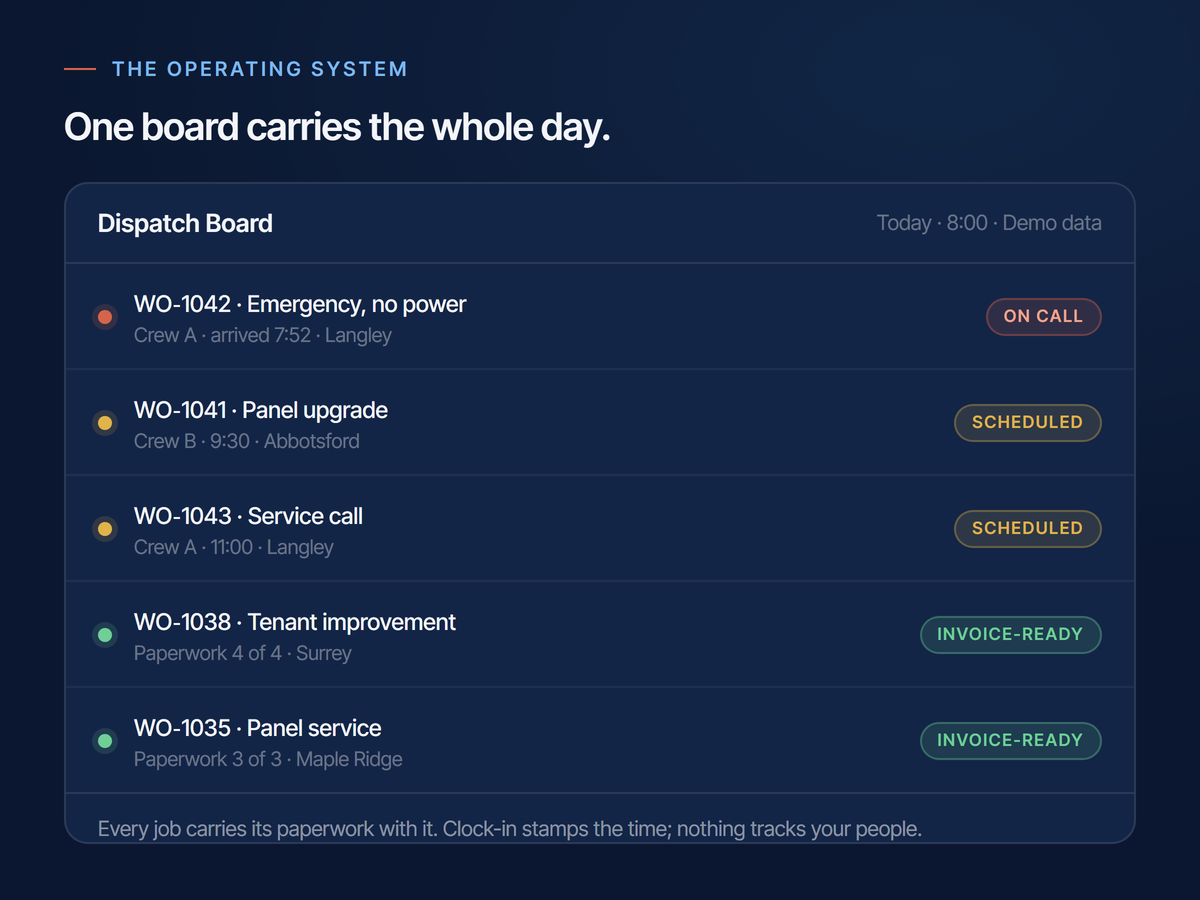
The accounting system stays where it is. QuickBooks, Sage or Spectrum keeps doing its job, and the operating system reads from it and writes back to it through integrations. A CRM and AI voice agents join the same application as modules, wherever the audit finds they pay.
Two levels, one application
A Business Operating System for the owner. A Team Operating System for each crew.
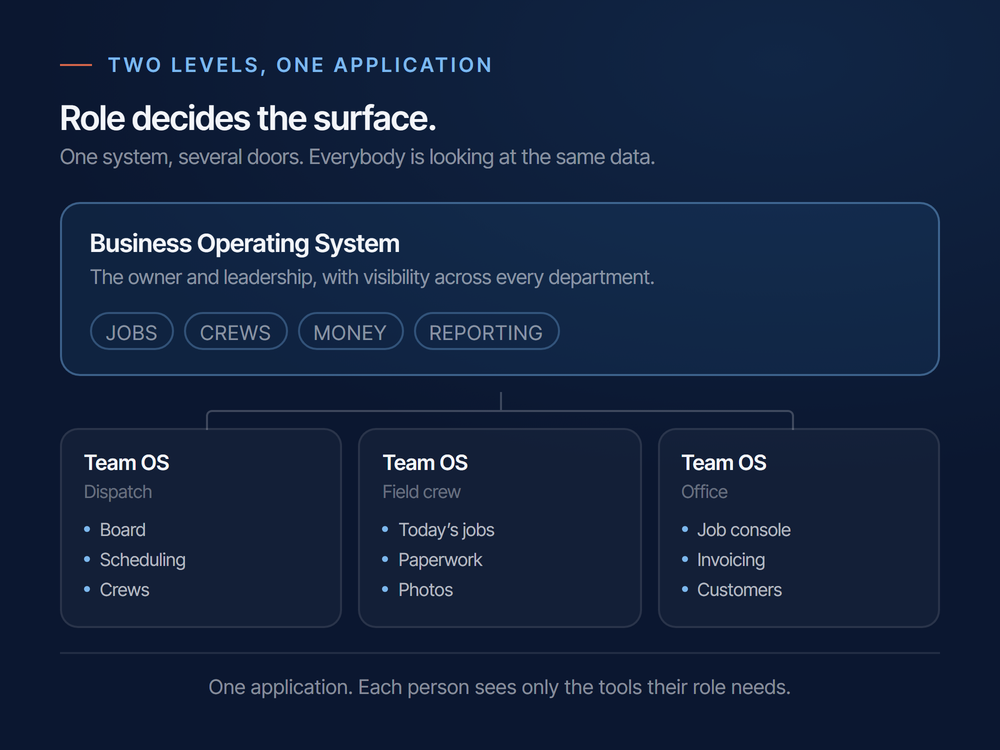
Role decides the surface. The Business Operating System is the owner’s view and leadership’s view, carrying visibility across every department at once: jobs, crews, money, and the state of the work as a whole.
A Team Operating System is one department’s surface. Each person opens the tools their role needs and nothing beyond them, so a technician sees today’s work orders and a dispatcher sees the board.
Both run inside one application. The dispatcher, the technician and the owner look at the same data at the same moment, through three different doors. One system, several surfaces, and no reconciliation between them.
Built with you
Built with you, and specified before anything gets built.
-
The audit is the specification
Every build opens with an AI Implementation Audit. ARDNT walks how work moves through the business, from first call to closed job, and hands back the specification of the operating system: which modules pay first, what each costs, and what to leave alone.
-
Narrow by design
The last tool the crew abandoned died of over-scoping. Every screen earns its place before it gets built, and a feature nobody opens is a feature nobody has to be trained on.
-
Modules added where they pay
The first module goes into production before the second one is built. The business gets a working piece early, uses it in anger, and the sequence after it follows what the audit found.
-
Infrastructure in the client’s own name
The operating system runs in the client’s own Cloudflare account. ARDNT builds it and maintains it, the client owns it outright, and the right to eject is written in from the first day. Protection by design.
AI sits inside the build wherever it pays: a voice agent answering the phone at seven in the evening, follow-up running without gaps, a summary drawn out of the day’s work orders. Where a plain rule does the job better than a model, ARDNT uses the rule and says so in writing.
In production
An operating system in production with live crews.
An electrical contractor in the Fraser Valley has run the day on one of these systems since August 2026. Before it, the office had adopted and abandoned two field tools and turned down a third for forcing GPS tracking on the crew. Every invoice waited on somebody searching a shared drive to prove the paperwork existed.
Work orders now leave one board. Paperwork is complete at the site, and the office receives an invoice-ready signal without asking anyone for it. The operating system carries the parts of the day the crew actually touches, and the crew kept using it.
Every build is custom to one client, and the core is in production today. Walkthrough demos are granted on request.
Who it’s for
Built for the owner who runs the work.
An operating system for trades businesses fits a particular shape of company: owner-led, a field crew with office coordination behind it, and work still moving on paper and phone calls.
-
Electrical and mechanical trades
Panel upgrades, service calls and tenant improvements: work carrying a job number, a crew, and paperwork attached to it.
-
Field service crews
Technicians on the road all day, with an office needing to know where every job stands without making a phone call to find out.
-
Owner-run operations
One approver, no committee, and an owner still close enough to the work to know exactly where it leaks.
-
Outgrowing the whiteboard
Dispatch has stopped fitting on a wall, and the spreadsheet beside it has stopped agreeing with it.
-
Lower Mainland and Fraser Valley
Langley, Surrey, Abbotsford and the rest of the region. Close enough to walk the yard and see the job the way the owner sees it.
How it starts
From a free assessment to an operating system, in modules.
-
The free assessment
Five minutes of questions about how the day runs, and a read on where the work leaks. Take the assessment without booking anything.
-
The review call
ARDNT walks the result with the owner and says plainly whether a build is the right move yet. A recommendation to wait is a real answer.
-
The AI Audit, $1,000
The specification of the operating system, delivered in five business days: the module map, the tool and fit review, cost and payback, and the build sequence. Proceed to a build and the $1,000 is credited toward it. See what the audit covers.
-
The first module in production
One working piece, live with the crew, before the next one is started. Adoption gets proven on something small.
-
Modules added where they pay
The operating system grows with the business, and each addition earns its place in the same way the first one did.
A smaller business with the time to build and without the budget for an installation takes the same sequence itself, through the ARDNT Academy. The method is identical, and a graduate arrives at a build with the foundations already standing and every account already in their own name.
Questions owners ask
Straight answers before the first call.
Is this another subscription?
One operating system, built for one business, running on infrastructure in the client’s own name. There is a monthly relationship with ARDNT, and it is worth being plain about what it covers: hosting, monitoring, and a system kept current as the business changes. Nobody sells a second product on top.
Do we replace our accounting software?
QuickBooks, Sage and Spectrum stay exactly where they are. The operating system reports and reconciles against the accounting package through integrations, so the books keep one home and the bookkeeper keeps the tool they know.
What happens with my crew?
Narrow by design is the answer to the tool they abandoned last time. There is nothing to install beyond a phone browser, the screens carry only the parts of the day the crew touches, and adoption gets tested on one module before the rest arrives. Clock-in stamps the time. Nothing tracks your people.
How long until something is in production?
The audit sets the sequence and lands in five business days. The first module goes live with the crew before the second one is built, so the business is running on a real piece of the operating system while the rest is still being made.
Where does our data live?
In the client’s own Cloudflare account, built and maintained by ARDNT. The client holds the keys and the right to eject, so nothing depends on the relationship continuing. Protection by design, and it is written into the engagement from the first day.
Does it use AI?
Wherever it pays, and the audit says where. Voice agents answer the phones, follow-up runs without gaps, and summaries come out of the day’s work orders. A plain rule often beats a model on reliability and cost, and ARDNT recommends the rule when the rule wins.
Read the transcript of the film
I run this company on six apps. I use a corner of each one. None of them do the thing I need most. I pay for a dozen tools every month. I have opened about a tenth of what they do.
So I stopped trying to fit my business into someone else’s software. Dispatch, jobs, photos, schedule, laid out the way my day runs. This one here.
Built for my business by me, with people who have done this before. One system, ours.
Built With You, ARDNT Solutions, 2026. Fifty-two seconds. The speaker is a scripted character, and the words are ARDNT’s own.
Find out where you stand.
The free assessment takes five minutes and shows where the day leaks. The $1,000 AI Audit turns it into the specification of an operating system, delivered in five business days.
Or reach us at hello@ardnt.io or 778-769-1188. More about the team behind the build, or see what ARDNT builds.